

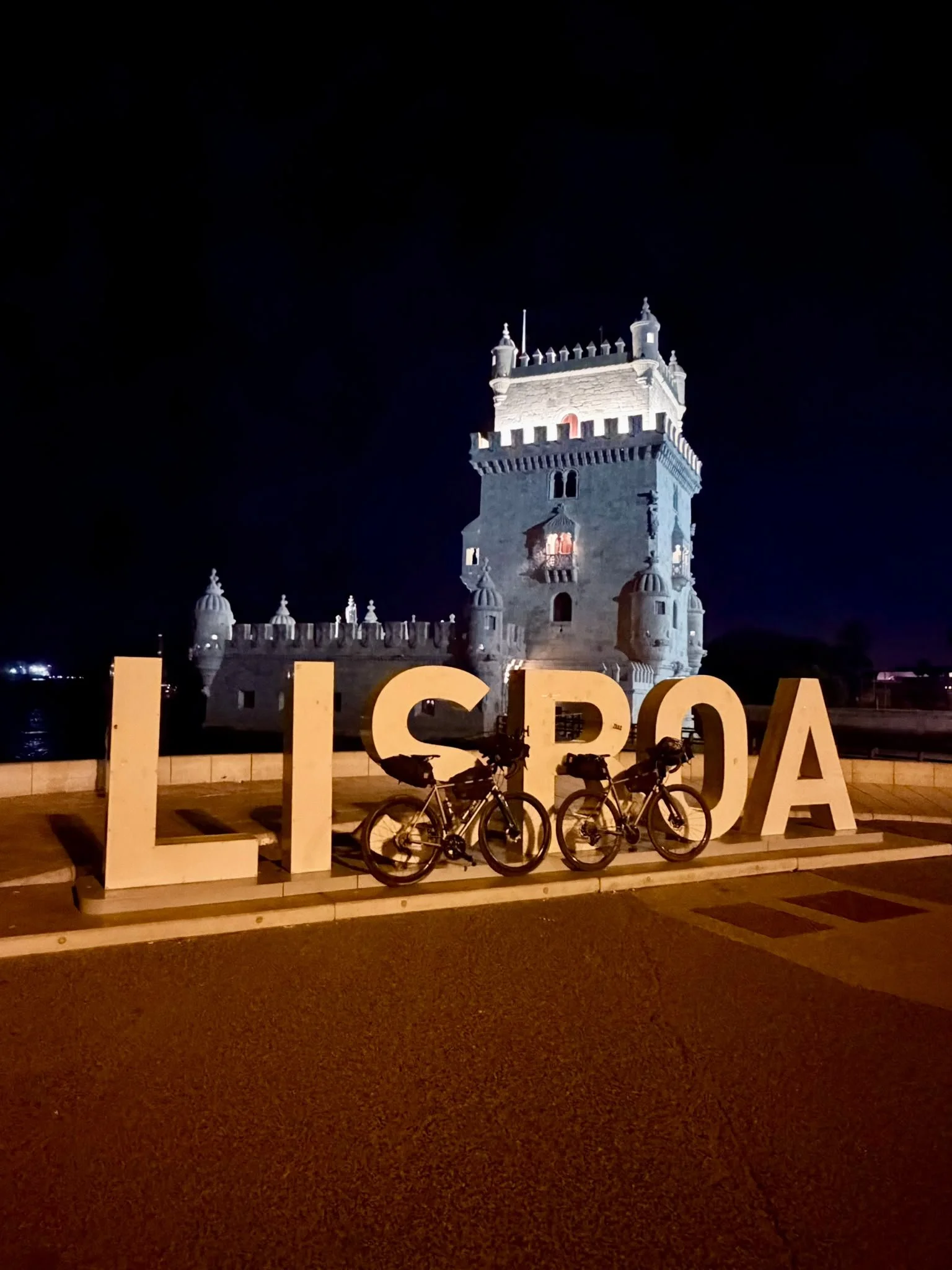
London to Lisbon. Sixteen riding days, eight World Heritage Sites, and numbers that refused to behave.
Day 8: Miranda de Ebro, northern Spain
Seventy-two kilometres covered, less than half the plan for the day. We were in bed by four in the afternoon.
The thermometer had reached 38°C. The inclines had gone into double digits. A thousand kilometres sat behind us and the only sensible thing left to do that day was stop.
We had set out to ride 2,026 kilometres from London to Lisbon. One kilometre for each year, a pound raised per kilometre, split between Shelter and Andy's Man Club. The route was built around eight UNESCO World Heritage Sites. Sixteen riding days. That was the plan, and somewhere around Day 8 the plan and we stopped speaking to each other.
We want to tell you about the eight sites. But the honest version puts them where they actually fell, scattered across a fortnight, with most days containing none of them at all, and every one of them arriving when we were in no state to take it in properly.
The one we didn't ride to
The Tower of London was Day 0. A rented flat by Tower Bridge, a bike built and repacked, zero kilometres logged. We stood and looked at it the evening before rather than flying past it the morning after, which turned out to be the right way round.
It is a building that has never settled on what it wants to be. William the Conqueror began the White Tower in the 1070s using limestone shipped over from Caen in Normandy. We would be riding through the country that quarried it within forty-eight hours. Henry III had it whitewashed in 1240 and gave it its name. Every coin in England was struck there from the reign of Edward I until 1810.
Our favourite part is the zoo. King John kept animals at the Tower from 1210, and over the centuries the collection ran to lions, elephants, ostriches and a polar bear. It closed in 1830, when William IV handed the survivors to the newly opened London Zoo.
Then we rode 135 kilometres to Portsmouth through roadworks and potholes, thinking mostly about the smooth roads that were yet to come in France, and got on an overnight ferry.
Mont-Saint-Michel, Day 2
Two things about the continent announced themselves straight away. The road surface was enormously better. And somebody had left the oven on with the fan running.
Mont-Saint-Michel sat about fifty kilometres out from the St Malo landing, on a day that finished at 175 kilometres.
The cult of Saint Michael arrived on that rock in 708AD. Benedictines began building from the 10th century, and the place held out through the Hundred Years War behind its ramparts and its tides. The Revolution turned it into a prison. It stayed one until 1863, by which point the buildings were close to ruin.
The tides are the thing you feel rather than read. The range here runs up to fifteen metres, and only tides above fourteen turn the Mont into a true island. The old causeway had been silting the bay for years, so a dam went in during 2013 and a new bridge opened in July 2014, letting the water move freely round the rock again. In March 2015 a supertide put that new bridge underwater.
There is a thread here worth pulling. St Michael's Mount in Cornwall was given to these same Benedictine monks in the eleventh century and run as their priory, with the buildings raised in the twelfth. The island most likely took its name from its French mother house. The Hundred Years War cut the cord when Henry V dissolved the alien priories, and the Mount passed to Syon Abbey in 1424.
Days 3 and 4 were 155 kilometres each. More liquid carried and drunk, more food, more weight, more time spent flat on the tri-bars. By then we had stopped thinking about Lisbon altogether. Lisbon was not a useful thought. The useful thought was the minimum distance for the day. That, and the French pastries.
Cordouan, Day 4
You cannot ride to Cordouan. It sits seven kilometres offshore near the mouth of the Gironde estuary, reachable only by boat at low tide, with 301 steps up to the lantern. Getting anywhere near it meant crossing the estuary by ferry to Le Verdon instead of running inland through Bordeaux, and finishing the day at Soulac-sur-Mer.
It is the strangest thing on the whole route. Building started in 1584 under Louis de Foix at the command of Henri III. Henri IV then approved a far grander scheme with a chapel and royal apartments added on. It was finished in 1611, twenty-seven years later. De Foix had spent his life and his own fortune on it and died before it was done.
There is a king's apartment on the first floor that no monarch has ever slept in. There is a chapel with stained glass on the second, which exists in no other lighthouse anywhere in the world. And in 1823 Augustin Fresnel tested his stepped lens here for the first time. It is the system now sitting in most of the world's lighthouses.
Then came Day 5, and we went all in.
The wind was relentless and the temperature held at 30°C, feeling more like 33. It had to be done for practical reasons. The 32 to 35°C range waiting across the Spanish border, on top of the daily climbing, was going to slow us badly. We needed breathing room before we got there.
Two hundred and sixteen kilometres. Finished around half past ten at night. The longest distance either of us had ridden, on the heaviest bikes we had ever ridden.
The Camino, Day 6
Our leg muscles spent that night discussing the previous day's events among themselves. We got very little sleep. They wanted to stop at Biarritz and make a weekend of it.
Day 6 was spent in every café along the route, and eventually out of France with 135 kilometres on the computer.
The Routes of Santiago de Compostela are the only entry on our list that is a network rather than a building. Four northern pilgrimage routes were added in 2015 to the Camino Francés already inscribed in 1993. The whole thing traces back to the ninth-century discovery of a tomb believed to be Saint James's, and in 1987 it became the first European Cultural Route.
There is something pointed about crossing it on a bike. Everyone else on it was walking, heading west to Santiago, taking weeks over it. We were heading south, taking days, and would be in another country by dinner.
Day 7 gave us San Sebastián, and we left it far too quickly. A small, beautiful town with ocean, beach and mountains all in one place. We ordered café con leche when the town deserved to be taken like a double espresso: short, bittersweet, and packing considerably more punch than our legs were ready for.
Then came the elevation. Then the high temperatures. And then, thankfully, the locals. A couple stopped to ask about the setup and the trip. Local riders offered hellos, wows and goodbyes over the next few kilometres. For a stretch it felt less like an endurance challenge and more like we had accidentally joined a very sweaty cycling parade.
The Atlantic vanished behind a long climb. It kept reappearing through gaps between houses and fences, and we kept standing up on the pedals to steal another look at it.
Days 8 and 9: The wall
Then Day 8, and the stop, and the four o'clock bedtime.
Day 9 we were awake at four in the morning instead. Riding in the dark was the only way to get hours in before the sun arrived. It worked until about half past seven, when the wind turned up uninvited at 43 km/h across semi-arid country and everything slowed again. Bearded vultures circling overhead did nothing for morale.
Seventy-eight kilometres into Burgos.
The cathedral there was begun in 1221 under Ferdinand III and Bishop Don Mauricio. It is the first Gothic cathedral in Spain, built by French architects who brought Paris, Reims and Amiens with them. It is also the only Spanish cathedral inscribed by UNESCO in its own right rather than as part of a city centre, which puts it in a category of one.
El Cid has lain in the transept beside his wife Doña Jimena since 1921. The Golden Staircase inside, by Diego de Siloé, is thought to have been the model for the grand staircase at the Paris Opera.
The detail we came away with is the Papamoscas. It is a figure on a sixteenth-century clock who opens and closes his mouth on every hour, for reasons nobody has ever satisfactorily explained.
The grind, Days 10 to 12
The wind dropped from 47 km/h to around 18, which felt a great deal less like cycling through a wind tunnel. Early starts helped. Day 11 even produced a tailwind. Free watts, always welcome, badly needed by that point.
Days 8 and 9 had made Spain feel like it was stretching out into infinity. Days 10 to 12 were different. Head down. Pedal. Eat. Drink. Find shade. Repeat.
The kit was getting looser and the legs leaner. Water stops tripled and food doubled. The bikes were the only things not losing weight.
Ávila came on Day 11, at 140 kilometres, and it is a climb. The town sits at roughly 1,130 metres.
The walls went up from 1090. Two and a half kilometres of perimeter, 88 semicircular towers, and nine gates finished across several different centuries. The cathedral's apse forms one of those towers, so the church is built into the defensive line rather than standing beside it. Building and maintaining the walls seems to have been a joint effort between the city's Christian, Jewish and Muslim residents. Saint Teresa was born there in 1515.
After a week of nothing but moving, arriving somewhere built specifically to stop people moving does something odd to your head.
Salamanca followed on Day 12, another 35°C scorcher, so we finished early and spent the evening cleaning and re-greasing the bikes.
The university was founded by royal decree in 1218 and has run without a break ever since, standing alongside Bologna, Paris and Oxford as one of the four great universities of medieval Europe. The Plaza Mayor came much later, built between 1729 and 1733 and designed to double as a bullring.
Salamanca hides jokes in its own stonework. There is a small stone frog perched on a skull on the university's entrance, and the legend says finding it brings luck in your studies. Better still, during restoration work in the 1990s, masons added an astronaut and a dragon eating an ice cream to the New Cathedral's Puerta de Ramos. Visitors have been squinting at them ever since.
Portugal, eventually
Day 13 and Portugal felt reachable. About 120 kilometres away, and the £2,026 target was already in the bank, which made the pull to finish stronger than the pull of a pastel de nata.
Then, seventy kilometres into another brutal day, the batteries in the electronic shifting ran out. Front and rear, in the hoods, within minutes of each other. That left gearing nobody had chosen, in heat that made flat roads feel like climbs. Ninety-two kilometres to Ciudad Rodrigo. Portugal could wait another day.
Day 14, fresh batteries fitted, everything repacked with aerodynamics in mind. The wind had dropped but the temperature kept climbing, and by midday our bodies made the decision the bikes would not. All we could think about was shade, water and somewhere cooler.
Then a campsite, and a woman we asked to fill our bottles. She disappeared behind a wall and came back with a completely frozen one-litre bottle of water. She refused payment. At 39°C it was the biggest ice lolly and one of the best-timed gifts anyone could have given us. The campsite also had a working swimming pool which we couln’t resist a dip in.
We got back on and rode well into the night. A hundred and fifty kilometres, and Lisbon finally on the map.
Day 15 the heat had the final say. A century was not happening. Eighty kilometres was all we had in us, and even that took everything. Sometimes the strongest thing available is to keep going when the number you wanted is out of reach.
Belém, Day 16
A hundred and eighty kilometres into Lisbon.
Jerónimos and the Tower of Belém hold a single UNESCO listing between them, inscribed in 1983. That surprises people who assume they are two separate sites. The logic is that they are one project. Both were commissioned by Manuel I, both built in the early 1500s, and both paid for by the sea. The monastery was funded through a five per cent tax on trade from Africa and the Orient, worth something like seventy kilograms of gold a year. The monks were there to pray for the king and to offer spiritual support to sailors leaving Lisbon.
The tower has the better story. Built between 1514 and 1519, it carries a stone rhinoceros on its façade. It commemorates Ganda, a live rhinoceros sent to Manuel I by the Sultan of Gujarat in 1515, and it is generally reckoned the first rhinoceros carved into European monumental architecture. Ganda caused a sensation in Lisbon, was shipped onward as a gift to Pope Leo X, and drowned at sea on the way.
Every one of these buildings exists because people were leaving from here and, with luck, coming back. That was the thought we finished on. Sixteen days moving slowly past eight places that were themselves all about movement: a fortified river port, a pilgrimage rock, a light to bring ships home, a road to a tomb, a cathedral on that road, and finally the point of departure for the open sea.
Two of them break the pattern, which is why we liked them. Ávila is walls built to keep people out. Salamanca is a university built to make people stay.
The number
We set out to ride 2,026 kilometres. We rode 2,093.
Sixty-seven over, and the reason is the sites themselves. They do not sit on a straight line between London and Lisbon. Reaching them meant not riding one.
The run out to Mont-Saint-Michel and back onto the line. Crossing the Gironde by ferry to Soulac instead of cutting inland through Bordeaux. Climbing to Ávila at 1,130 metres rather than going round it.
We could have hit 2,026 exactly. It would have meant dropping two of the eight, and the eight were the whole point.
2,093 kilometres. Sixteen riding days. Eight World Heritage Sites. £2,026 raised for Shelter and Andy's Man Club.
Our JustGiving page is still live: Please donate at JustGiving-London2Lisbon2026, and follow the training, the route and the ride itself on Instagram and LinkedIn .
“If you can't fly, run. If you can't run, walk. If you can't walk, crawl, but by all means, keep moving forward.”
- Martin Luther King Jr.